A8550MA1 AI Compute Platform
Product Overview
The APX8550 motherboard is based on the Qualcomm QCS8550, a flagship SoC designed for high-end edge AI and smart terminals. The QCS8550 integrates a hexa-core (octa-core optional) Kryo CPU, Adreno 740 GPU, 48 TOPS NPU, 8K VPU, and Spectra ISP. The motherboard supports dual RJ45 Gigabit Ethernet ports, USB 3.0 Type-A, and extended USB 2.0 connectors, along with MIPI DSI, MIPI CSI, HDMI, LVDS, and eDP display interfaces. It also supports multiple SPI, I2C, RS485, UART, I2S, CAN, and GPIO general-purpose bus interfaces. An onboard WiFi module supports WiFi 6 and BT 5.3, and a standard Mini-PCIe interface enables 4G communication expansion. A Micro SD card slot provides external storage expansion, and audio input/output interfaces are included. The board is purpose-built for high-compute, high-stability scenarios such as robotics, industrial AI, and high-end IPC/VR applications.
This motherboard features strict material selection and design for ultra-slim applications. Its compact dimensions and rich interfaces facilitate integration into finished products, delivering a smooth experience and powerful performance for digital signage, interactive touch, consumer electronics, entertainment systems, and other industries.
Product Appearance
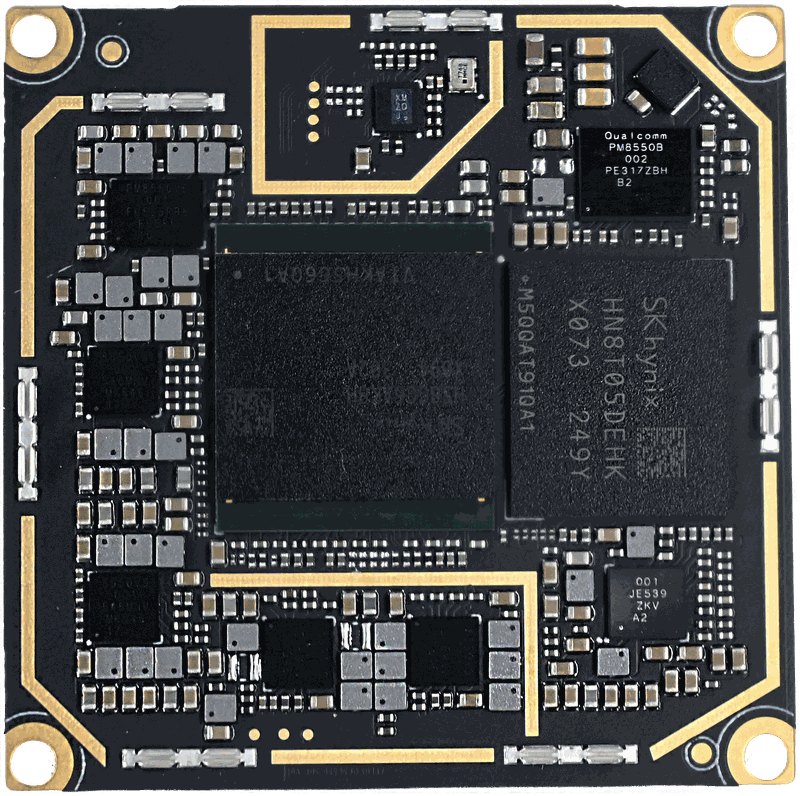
Front
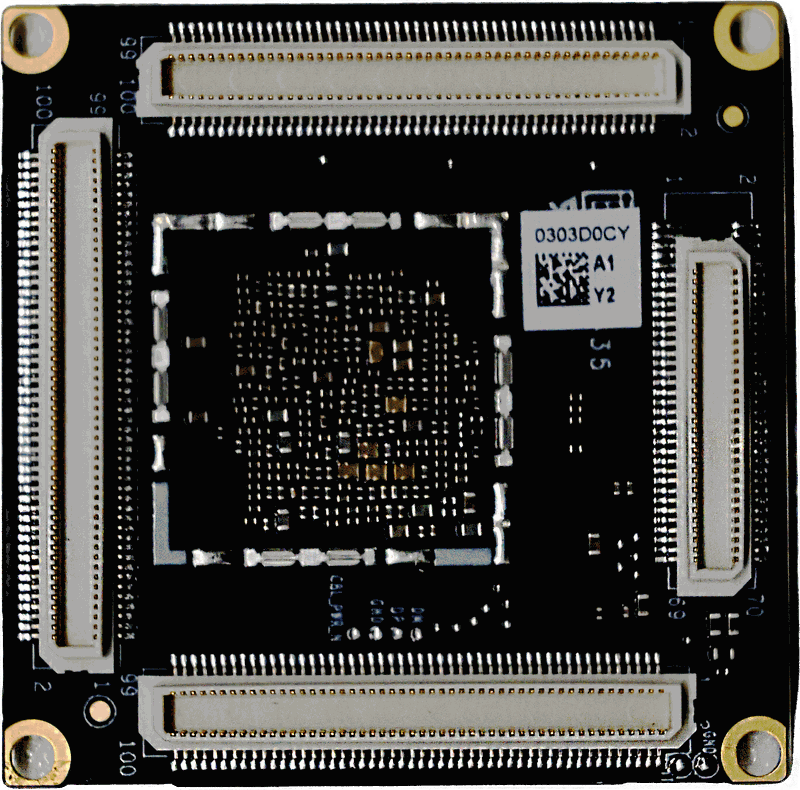
Back
Specifications
| Category | Description |
|---|---|
| CPU | QCS8550, 1× Prime Core + 2× Gold Core (4× optional) + 3× Silver Core, max 3.2 GHz |
| DDR | LPDDR5x 12 GB (8 GB / 12 GB / 16 GB / 24 GB optional) |
| Storage | 128 GB UFS 3.1 standard, expandable up to 512 GB |
| TF Card | Push-push TF card slot, up to 256 GB |
| USB | 2× Type-A (USB 3.0 ×2), 4× internal 1.25 mm vertical connectors (USB 2.0 ×4), 4× 2.0 mm horizontal connectors (USB 2.0 ×4) |
| HDMI | Standard HDMI display interface, supports 4K@60 Hz output |
| eDP | Industry-standard 30-pin eDP connector |
| LVDS | 30-pin industry-standard dual-channel LVDS interface, supports VESA/JEITA formats, up to 1080p output |
| Backlight Control | Industry-standard LCD backlight control interface (LVDS and eDP), supports backlight on/off and brightness adjustment |
| Camera | 2× MIPI CSI × 4-lane |
| I2S | 1× I2S interface, supports low-power voice processing and audiophile-quality playback (4 microphones) |
| Ethernet | 2× 10/100/1000M auto-negotiation RJ45 ports |
| Mini-PCIe | Industry-standard m-PCIe 4G module interface |
| SIM Card | Push-push Nano SIM card slot, supports mobile communications |
| CAN | 2× CAN header interfaces |
| Headphone/Mic | CTIA-standard 4-pole headset 3.5 mm jack (L-R-GND-MIC) |
| I2C | I2C headers and FPC interfaces (shared with SPI), supports I2C touch expansion |
| SPI | 2× independent SPI header interfaces, 1× shared with I2C |
| GPIO | Supports external expansion of 10× 1.8 V GPIO |
| Serial Communication | 2× RS485 + 6× UART |
| Buttons | Flash key (RECOVERY) + Power key |
| Power Input | Supports 10–24 V wide-voltage DC input |
| Debug Interface | Supports external 3.3 V serial debug |
| Line Out | Standard L/R channel line output (header interface + headphone jack) |
| WiFi / Bluetooth | Onboard WiFi 6 + BT 5.3 |
| Environmental | Operating temperature -25°C ~ +50°C, operating humidity 0%–95% (non-condensing) |
| OS | Android 15 / Ubuntu 22.04 |
System Platform
System delivery method: APLUX Full Image — a complete image preloaded with Ubuntu 22.04 + AidLux + AI SDK + Demos, ready to use out of the box.
Quick Access
 Product Overview
Specs, appearance, interface definitions, software stack, and image descriptions
 Getting Started
Quickly learn platform features and getting-started steps
 Core Board System & Source Development
BSP source development, kernel & driver adaptation, firmware flashing
 Peripheral Development Guide
Multimedia, camera, and display peripheral development
 AI Application Development & Model Deployment
AI inference, LLM deployment, model optimization
ResourcesFirmware, tools, and design reference downloads
 FAQ & Troubleshooting
Common questions & solutions